Some thoughts about approaching Chinese study as a heritage student.
The Background
I grew up in a Chinese-speaking household, and had a typical experience of studying the language over the weekends at a Chinese school with 马立平 books. After taking the AP Chinese exam in high school, my formal study essentially ended as I started filling my life with other college-appealing extracurriculars. I still continually spoke Chinese to my parents, but not quite as often after I began college.
Thus, this was my starting point, several years after stopping my studies:
- Reasonable fluency in spoken Chinese; able to hold basic conversations. Mostly limited by vocabulary, not grammar.
- Poor reading and writing skills; texting using Pinyin for only basic communication, and needing a dictionary/translation for anything more complex.
A study strategy
About a year ago, I was inspired by a particular blogpost to rekindle my study of Chinese. My primary goal was the ability to consume typical Chinese internet media, like webtoons, 武侠 novels, or reading the various articles my mom sent me on Wechat.
Specifically, I wanted some relatively low-effort method to grind out my vocabulary, which Anki seemed perfect for. I decided to pick the HSK vocabulary as a benchmark to work on, as it seemed like a reasonable sorting of vocab words by frequency (and there were plenty of preexisting Anki decks for it).
A brief overview of HSK
The HSK (汉语水平考试) is a standardized comprehension test for Simplified Chinese, with difficulty levels ranging from HSK 1-6, beginner to advanced (new levels were introduced recently, but we can ignore those for now). As I stopped studying at an AP Chinese level, this was approximately equivalent to a HSK 4 level. HSK 4 consists of around 600 words, HSK 5 has 1300, and HSK 6 has 2500. Recently it's been expanded to 7-9 as well,
What I learned
There aren't many tricks to memorizing characters, unfortunately. Every rule that you can find will have some exception, much like how English grammar and pronunciations are so diverse. One suggestion for difficult ones is to break down the character into its subcomponents and then make up some sort of story to remember the meaning. However, Chinese phrases often consist of multiple characters which may have different meanings in different contexts, like 容纳 and 归纳.
I found it easiest to do my studying immediately before going to sleep. Initially I tried to replace my media browsing time (like while commuting), but it didn't work very well for me. Personally, I think setting a bit of time specifically for studying makes it easier to do as a habit. As a bonus, it makes falling asleep easier as well...
As I progressed more and saw new words more frequently, I started to fall into the hole of having too many reviews per day. At a certain point, this meant 40+ minutes of studying per day, which really burnt me out.
I think aggressively decreasing new words as they got more difficult was very effective in maintaining my sanity and my study habits. Keeping the study duration to ~20 minutes/day feels much more maintainable.
What I could have done better
I'll be honest, I'm extremely lazy. When I first set up Anki, I just googled "HSK 6 Anki" and picked a random one that seemed reasonable (it had audio and synonyms and stuff!). In hindsight, the right play is to make your own. I could've put maybe 2-3 hours of effort in taking the existing wordlist and improving it with external sources, but I just haven't bothered to do it.
The current flashcard set I'm using has the word + definition + incomplete syntax + incomplete synonyms + a few minor mistakes. I think it would do wonders to automatically populate the syntax and synonyms from various dictionaries, and add some sentence examples as well. I think sentence examples would be a particularly useful addition, since it's difficult to 死记硬背 words without any context whatsoever. I've done some light manual editing of the flashcards, and it's a bit better but still incomplete. If you're interested, feel free to contact me and I'll share my current deck.
The other thing that I messed up was not consuming more Chinese content while studying. My initial reading level was pretty horrible - for a regular manga, I would have to look up words every few sentences. Approximately midway through my HSK6 cards, I felt like I was able to read much more fluidly. I underestimated the usefulness of consistent reading practice outside of Anki. I'm pretty annoyed when I can't read things as fast as I can in English, but I think switching to Chinese for things like phone language settings and reading news is too good for learning. It really depends on what kind of stuff you're interested in, though.
Moving forwards
I'm almost finished with HSK 6, and I'm going to just try to shift my media consumption over a bit and work on more practial usage. I have a pretty good extension installed that lets me hover over characters to look at dictionary definitions. It's not quite useful for manga and non-selectable text though. There's an opportunity to make a OCR extension on hover, but we'll see if I ever get around to doing that.
I also plan to browse more net forums for hobbies that I enjoy. Chinese netslang is somewhat different from what the HSK prepares you for... but that's the same as in English as well. It's good to have Chinese friends around to ask for help!
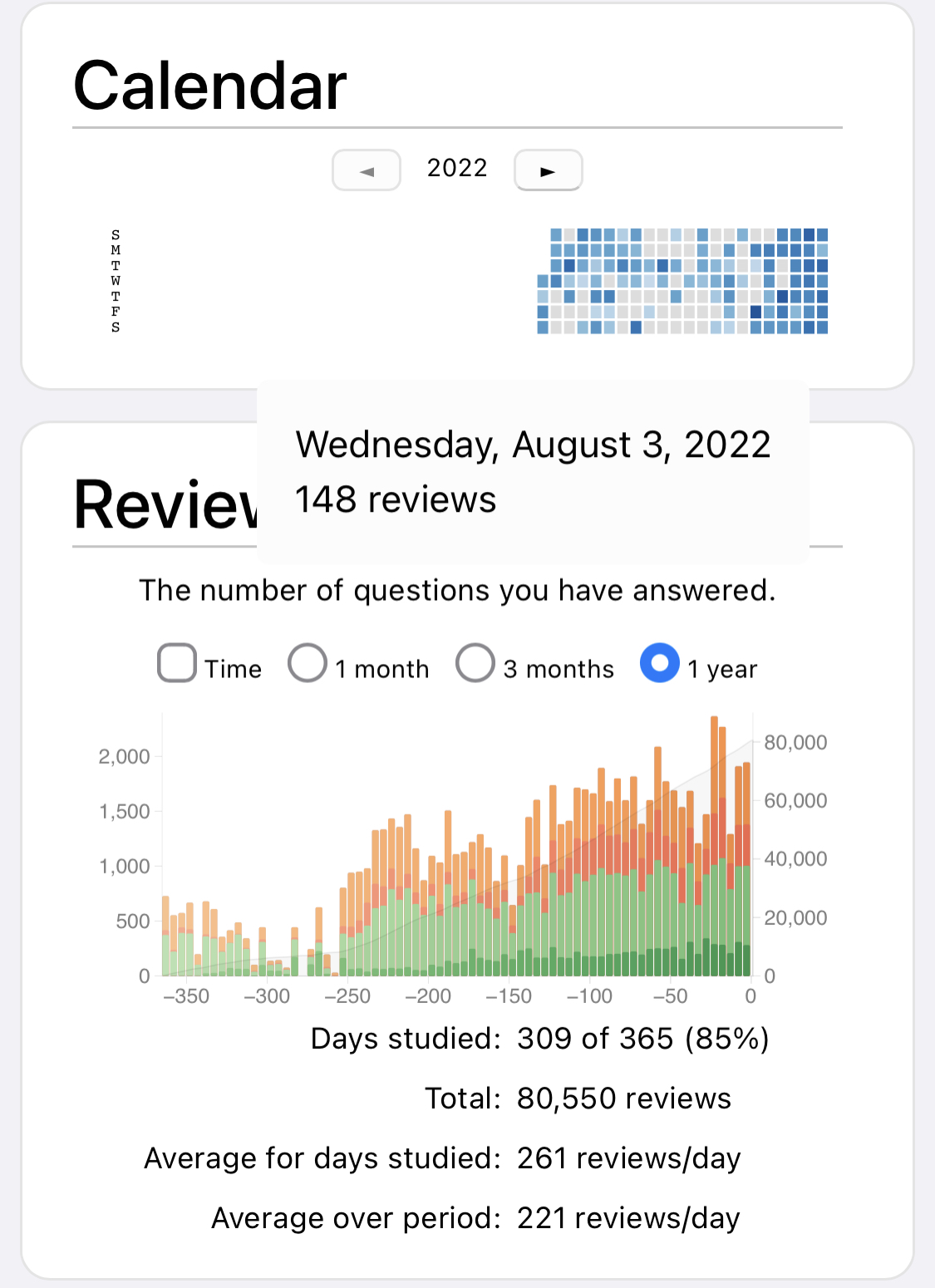
Time flies!